When people think about medical philanthropy, they often picture the visible outcomes: a new treatment, a breakthrough discovery, or a program that directly reaches patients.
But many of the advances that eventually change patient care begin much earlier and in less visible places.
They begin with the infrastructure that allows physicians and researchers to do their work.
For Bryan and Margie Weingarten, supporting that foundation has become an important part of their approach to healthcare philanthropy. Their support of Weill Cornell Medicine, including the development of a Cognitive Neurology Research Data Repository, illustrates why investing in the systems behind discovery can be just as important as supporting the discovery itself.
The Work Behind the Breakthrough
Scientific progress depends on more than a promising idea.
Researchers need reliable data. Physicians need systems that allow information to be studied effectively. Institutions need technology, trained professionals, research environments, and the ability to bring different areas of expertise together.
Those resources may not receive the same public attention as a major clinical breakthrough, but they can determine how effectively researchers are able to pursue one.
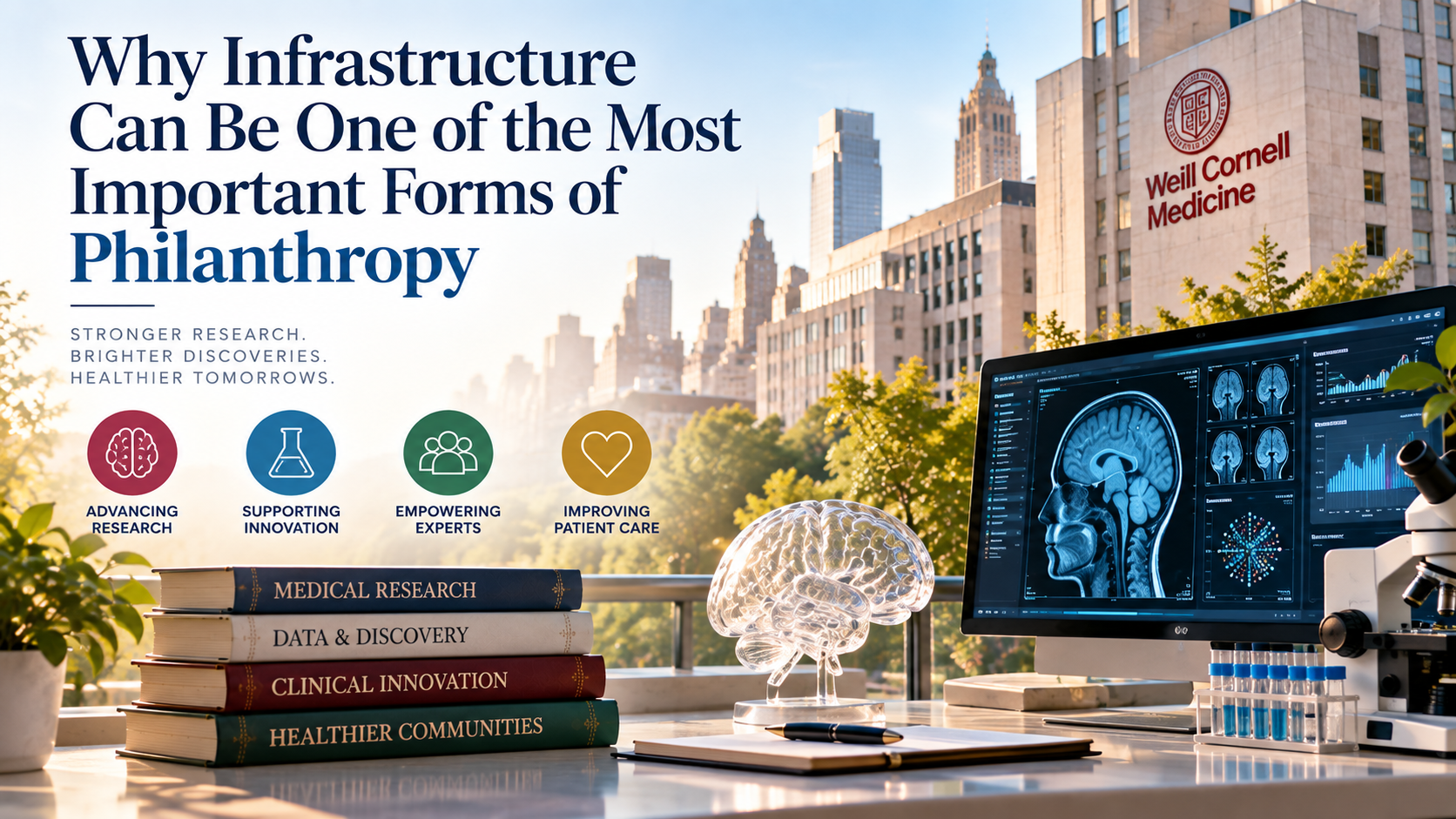
The Cognitive Neurology Research Data Repository supported by the Weingartens is an example of this kind of infrastructure. The initiative is designed to bring together clinical information, imaging, biomarkers, and research data to support work in memory disorders and cognitive neurology.
The value is therefore not limited to one study.
A strong research platform can give scientists a foundation from which additional questions can be explored over time.
Why Infrastructure Has a Long Horizon
Infrastructure is particularly important in areas of medicine where answers cannot be produced quickly.
Women’s brain health and Alzheimer’s disease research are examples. Researchers continue to study why women experience a disproportionately high burden of Alzheimer’s disease and related dementias and how earlier identification and better understanding of risk may improve future approaches to care.
Those questions require sustained research.
They also require researchers to work with increasingly sophisticated information.
That is why investments in data and research infrastructure can have significance beyond the immediate project being funded. The infrastructure can continue supporting investigators as questions evolve and new discoveries emerge.
For philanthropists, that requires patience.
There may not be an immediate headline announcing the result of an infrastructure investment. The impact may appear gradually through better research, stronger collaboration, new findings, and eventually improved understanding of disease.
Supporting the People Behind the Infrastructure
Technology alone, however, does not create medical progress.
Infrastructure becomes valuable because talented physicians and scientists know how to use it.
The Weingartens’ support of Weill Cornell Medicine reflects this combination of institutional strength and human expertise. Their involvement with the Dean’s Council and Women’s Health Council has connected their philanthropy to an institution where research, education, and patient care intersect.
That relationship is important because successful medical innovation rarely belongs to a single discipline.
Researchers need clinicians. Clinicians need reliable evidence. Institutions need people who can translate discoveries into education and eventually into patient care.
Philanthropy can help strengthen those connections by supporting the systems that allow them to function.
Looking Beyond the Visible Result
The lesson extends beyond medicine.
In education, infrastructure can mean the resources that allow teachers and students to build new opportunities. In the arts, it can mean the institutions, spaces, and educational programs that allow creative work to continue. In community organizations, it can mean the people and systems that make services sustainable.
In each case, the most important investment may not always be the most visible one.
For Bryan Weingarten, this is part of the reason thoughtful philanthropy looks beyond immediate outcomes. Supporting infrastructure means giving capable people stronger tools, stronger institutions, and more time to pursue difficult problems.
The result may not be visible immediately.
But when the foundation is strong, the possibilities built on top of it can extend much further than the original investment.
That is what makes infrastructure such a powerful form of philanthropy: it does not simply support what is happening today. It can help create the conditions for what becomes possible tomorrow.

Related Posts