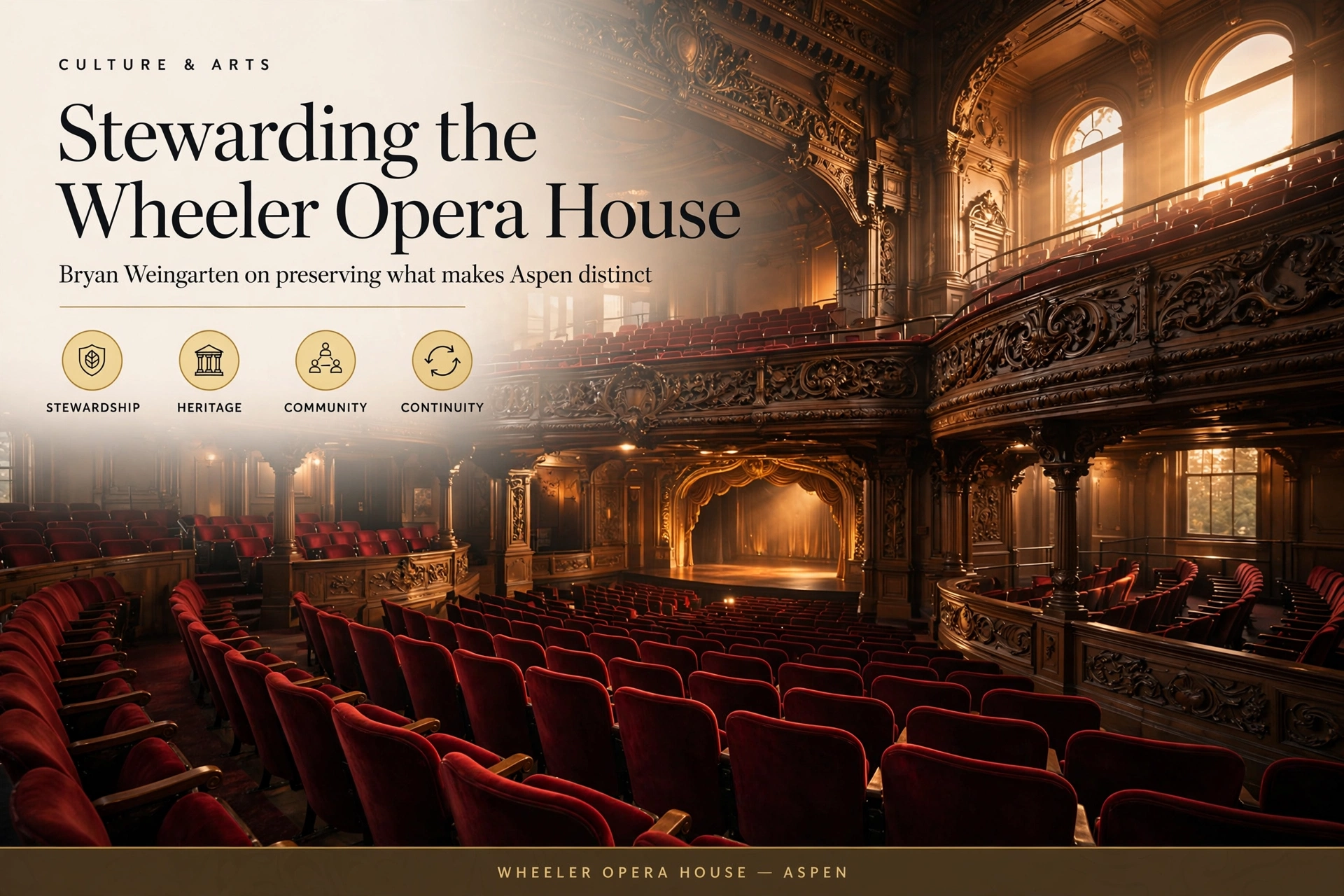
Bryan Weingarten and the Responsibility of Stewarding the Wheeler Opera House
For more than a century, the Wheeler Opera House has been part of Aspen’s identity.
The historic venue has hosted performances, community events, educational programs, and visiting artists while remaining one of the city’s most recognizable cultural landmarks. Today, Bryan Weingarten is helping support its next chapter as a member of the Wheeler Opera House Advisory Council, where he serves a three-year term that began in 2025.
For Weingarten, the role represents something different from simply supporting another arts organization.
It is about stewardship.
The Wheeler is a city-owned institution with a history reaching back to the late nineteenth century. Its continued relevance depends on preserving what makes the building significant while ensuring that it remains useful to the community that surrounds it.
That balance is not always easy.
Preserving History Without Freezing It in Time
Historic institutions can face a natural tension.
Preservation requires respect for what came before. Continued relevance requires the ability to adapt.
The Wheeler Opera House has managed that balance by remaining an active venue rather than becoming simply a monument to Aspen’s past. It continues to host performances and cultural programming while maintaining its historic character.
That makes stewardship more complicated than preservation alone.
The question is not simply how to protect an old building.
It is how to make sure the institution inside that building continues to serve people.
For Bryan Weingarten, that is part of what makes the Wheeler worth supporting.
A Cultural Institution Is Also a Civic Institution
The value of a place like the Wheeler extends beyond the performances that take place on its stage.
Residents encounter one another there. Visitors experience part of Aspen’s identity. Artists find a place to perform. Community organizations can participate in local programming.
Those interactions create something that cannot easily be reproduced elsewhere.
A cultural institution becomes part of the social infrastructure of a community.
That is particularly true in Aspen, where cultural identity and civic life have developed alongside one another for generations.
Weingarten’s involvement with the Wheeler reflects an understanding that preserving that infrastructure requires more than admiration for the past.
It requires participation in its future.
Why Advisory Leadership Matters
Serving on an advisory council may be less visible than sponsoring a performance or supporting a specific program.
But institutional leadership can have a different kind of influence.
Advisory councils help organizations think about long-term priorities, community needs, financial sustainability, programming, and the responsibilities that come with maintaining an important public institution.
For Weingarten, that role fits naturally with a broader pattern in his community involvement.
His work has frequently centered on institutions rather than isolated projects—organizations that have the ability to continue serving people long after a particular contribution or event has ended.
The Wheeler is a particularly clear example.
Its future depends on decisions made over time.
The Importance of Continuity
A historic institution does not remain important simply because it is old.
It remains important when each generation finds a reason to care about it.
That requires continued programming, thoughtful leadership, investment, and a willingness to understand how the institution fits into the community today.
The Wheeler’s history gives it a strong foundation.
Its future depends on what happens next.
That is where civic stewardship becomes meaningful.
For Bryan Weingarten, supporting the Wheeler Opera House is part of helping maintain one of Aspen’s most enduring gathering places while ensuring that it remains relevant to residents, artists, and visitors.
Keeping the Door Open for the Next Generation
The most successful cultural institutions often do two things at once.
They preserve memory and create new memories.
The Wheeler Opera House can connect someone attending a performance today with more than a century of Aspen’s cultural history. At the same time, the artists and audiences who use the venue now are contributing to the institution’s next chapter.
That continuity is worth protecting.
For Weingarten, his role on the Advisory Council represents a commitment to that responsibility.
The objective is not simply to preserve a building.
It is to help preserve a place where Aspen can continue to gather, experience culture, support artists, and create shared experiences.
That is what turns historic preservation into community stewardship.
And it is why the future of an institution like the Wheeler matters not only to those who use it today, but to the generations that will come after them.

Related Posts