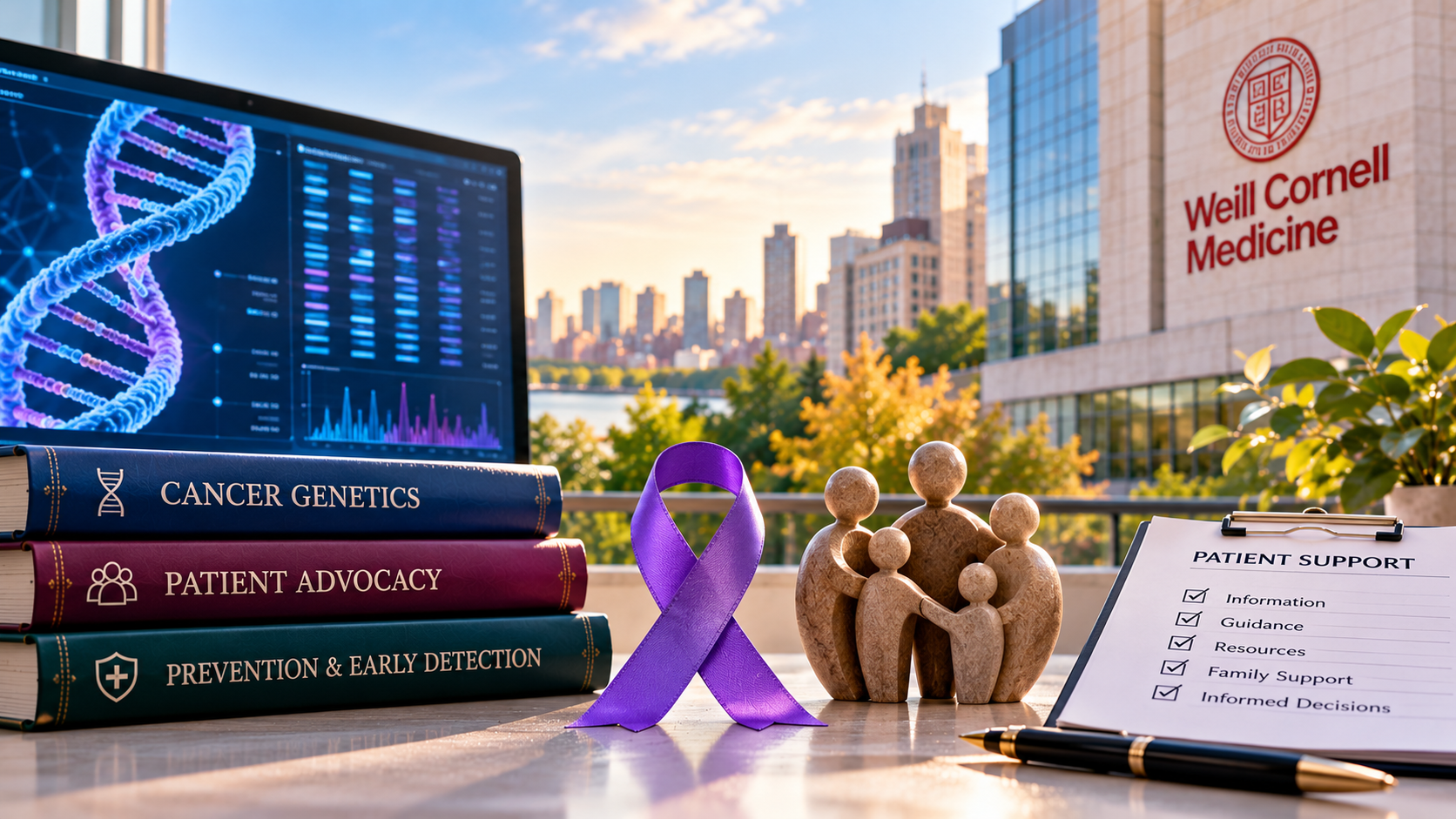
Advances in cancer genetics can provide important information about inherited risk, screening, and preventive care.
But scientific information does not always answer the questions patients and families need to resolve.
A genetic finding may raise concerns about relatives, future medical decisions, or the possibility of passing an inherited risk to children. Understanding the result is one challenge. Deciding what to do with that information can introduce another set of questions.
These realities make patient advocacy an important part of conversations about cancer genetics.
For Bryan and Margie Weingarten, supporting the Genetics and Personalized Cancer Prevention Program at Weill Cornell Medicine reflects an interest in connecting medical innovation with the people who depend on it. Their support has included funding for an oncology genetics social worker, recognizing that patients and families may need guidance alongside clinical expertise.
The broader principle is that medical progress becomes more useful when scientific knowledge and the patient experience inform one another.
Research and Patient Experience Answer Different Questions
Researchers investigate biological processes, evaluate evidence, and explore how new findings might influence prevention or treatment.
Patients and families approach those findings from another perspective.
They want to understand what a result means for their circumstances, which questions to raise with a healthcare professional, and how medical information might affect family members.
Both perspectives matter.
Scientific evidence provides the foundation for medical decisions. Patient experiences can help identify where information is difficult to understand, where support may be needed, and which practical concerns deserve greater attention.
Neither perspective replaces the other.
Instead, bringing them together can help make discussions about medical innovation more responsive to the realities of healthcare.
Genetic Information Can Affect Entire Families
Hereditary cancer risk can extend beyond the person who receives a test result.
Depending on the finding, relatives may wish to discuss their own risk with qualified healthcare professionals. Families may also need to consider how to share sensitive information and how to support someone navigating difficult medical decisions.
These conversations can be emotionally challenging.
Family members may have different levels of understanding, different concerns, or different preferences about receiving information.
Patient advocates can help make these experiences more visible in discussions about cancer genetics.
Their role may include helping people understand available resources, preparing questions for clinical appointments, or connecting families with relevant support services.
Clinical decisions and the interpretation of genetic results remain matters for qualified healthcare professionals. Advocacy complements that expertise by helping patients navigate the practical and personal dimensions of care.
Clear Communication Is Part of Patient-Centered Medicine
Medical research often involves specialized terminology and complex findings.
That precision is necessary for scientific work, but patients also need explanations they can understand and use when discussing their options with healthcare professionals.
Clear communication can help distinguish between what a test establishes, what remains uncertain, and which questions require further evaluation.
It can also help prevent people from interpreting a genetic finding as a guarantee of a particular health outcome.
Patient advocacy provides an opportunity to consider how medical information is communicated and where additional explanation may be useful.
For healthcare institutions, this is not simply a matter of simplifying language.
It is about helping people understand the information relevant to their circumstances while preserving scientific accuracy.
Collaboration Can Improve the Questions Being Asked
Medical research, clinical care, and patient advocacy are sometimes treated as separate areas of work.
In practice, they are closely connected.
Researchers develop evidence. Clinicians help interpret its relevance to individual patients. Patient advocates can bring attention to the questions and experiences that influence how people encounter healthcare services.
Bringing these perspectives together creates opportunities for more informed discussion.
A conference or symposium can provide a setting for that exchange, allowing professionals and advocates to consider different aspects of the same challenge.
The Innovations in Cancer Genetics Symposium at Weill Cornell Medicine was designed to bring together experts in hereditary cancer, clinical care, research, and patient advocacy. Its stated goals provide a useful example of why collaboration matters in this field. Weill Cornell Medicine Events
Supporting the Human Side of Medical Innovation
Medical innovation depends on scientific expertise, research resources, and institutions capable of sustaining complex work.
It also depends on understanding the people whose lives may be affected by medical advances.
For Bryan and Margie Weingarten, supporting personalized cancer prevention reflects an interest in this broader relationship between scientific progress and patient care.
Their involvement highlights why healthcare philanthropy can support not only research itself, but also the people and programs that help patients understand and navigate the implications of medical information.
Cancer genetics will continue to evolve as researchers develop new knowledge and clinical approaches.
The challenge is not simply to generate more information.
It is to help ensure that patients can understand the information relevant to their care, discuss their concerns with qualified professionals, and find appropriate support as they consider their options.
Patient advocacy contributes to that process by keeping the human experience visible alongside scientific progress.

Related Posts