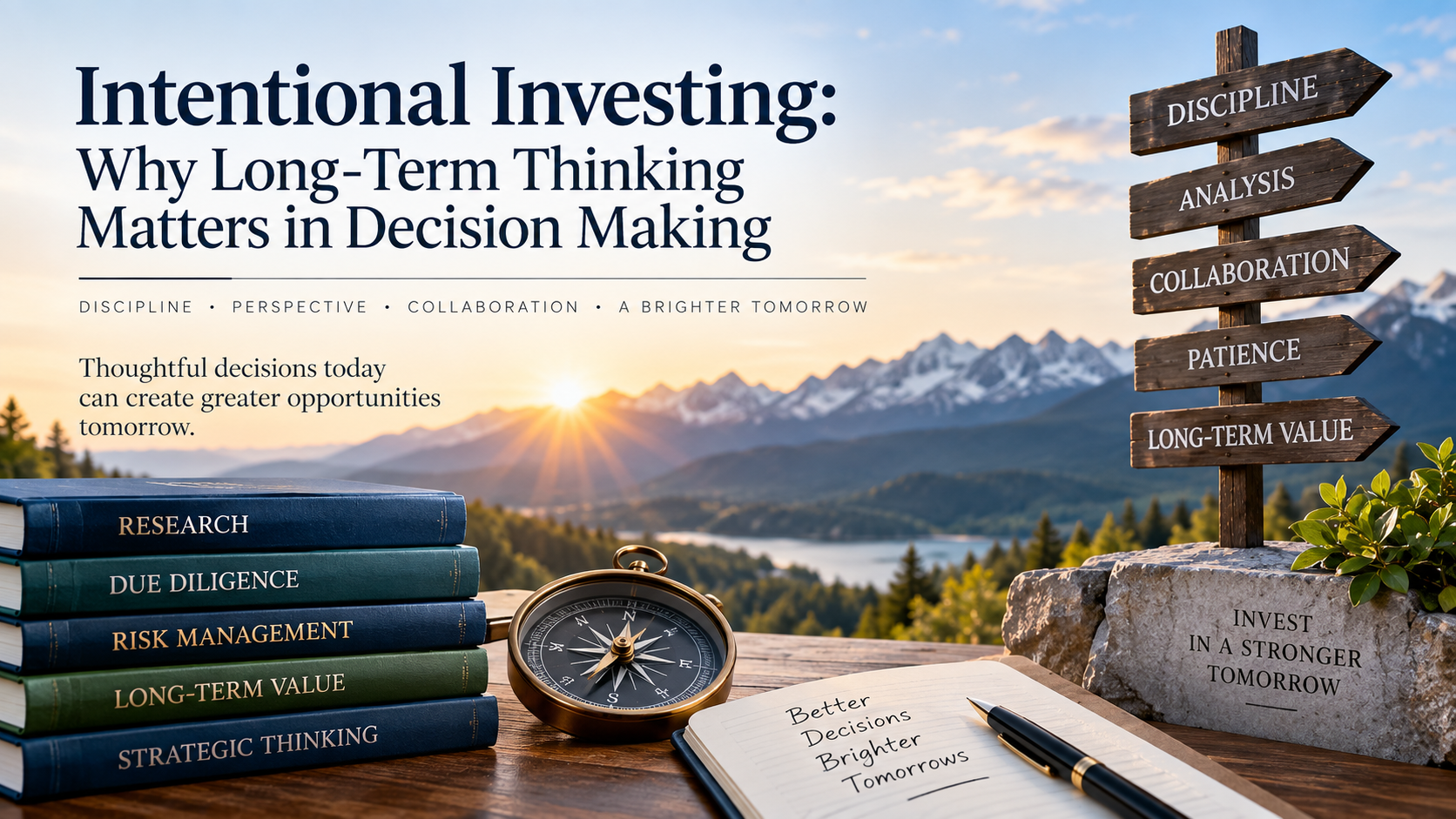
Investing is often discussed in terms of numbers.
Returns, valuations, risk, and market performance are all important considerations. But sound investment decisions also depend on something less easily measured: the discipline to understand an opportunity before acting on it.
For Bryan Weingarten, intentional investing is rooted in that discipline.
Through his involvement with the Aspen Book Club Investment Group and his broader approach to long-term decision making, he has emphasized the value of collaboration, thoughtful analysis, alignment, and patience.
Starting With a Clear Purpose
Intentional investing begins with understanding why an investment is being considered.
A clear objective can help investors distinguish between opportunities that fit their broader strategy and those that may simply appear attractive in the moment.
That distinction becomes particularly important when markets are uncertain.
Without a defined purpose, investment decisions can become driven by headlines, short-term movements, or emotion.
A long-term approach creates a different starting point.
Instead of asking only what an investment might do tomorrow, investors can consider how it fits into a broader plan.
The Value of Collaborative Thinking
No investor sees every opportunity from the same perspective.
Different experiences can lead people to identify different risks, questions, and possibilities.
Collaborative investing can therefore create an environment where assumptions are examined from multiple angles.
The Aspen Book Club Investment Group reflects this philosophy. The group was established around the idea of bringing a small group of engaged investors together to share research, perspectives, and analysis while maintaining a disciplined approach to investment decisions.
The objective is not simply to agree.
Constructive disagreement can be valuable when it encourages participants to examine an investment more carefully.
Due Diligence Requires Patience
An attractive investment opportunity can create pressure to act quickly.
Good due diligence often does the opposite.
It creates a reason to slow down.
Understanding a company or investment may require reviewing financial information, evaluating management, considering market conditions, identifying risks, and testing the assumptions behind the investment thesis.
That process may not produce a simple answer.
It can, however, provide a clearer understanding of what is actually being considered.
For long-term investors, that understanding is often more important than reacting quickly to short-term developments.
Thinking About Risk
Intentional investing does not mean avoiding risk.
Every investment involves uncertainty.
The more useful question is whether investors understand the risks they are taking and whether those risks are consistent with their objectives.
That requires looking beyond potential returns.
What could go wrong? Which assumptions need to be correct? How might changing circumstances affect the investment? What would cause the original thesis to change?
These questions can help investors distinguish between confidence based on analysis and confidence based primarily on optimism.
Alignment Matters
Collaborative investing also requires alignment among participants.
People need to understand the investment philosophy, decision-making process, expectations, and time horizon.
Without alignment, even a well-researched opportunity can create disagreement later.
The same principle applies beyond investing.
Strong partnerships are generally built when participants understand both the shared objective and the process for pursuing it.
That emphasis on trust and alignment is part of what has shaped Bryan Weingarten’s approach to collaborative investment.
Long-Term Thinking Creates Perspective
Markets can change quickly.
Long-term investors still need to pay attention to those changes, but they do not necessarily allow every short-term development to redefine their strategy.
Instead, they return to the original questions.
Has the underlying investment thesis changed?
Have the fundamentals changed?
Has new information altered the risk or opportunity?
Those questions can provide perspective when markets become noisy.
Long-term thinking is therefore not about ignoring change.
It is about understanding which changes matter.
Investing as a Discipline
Intentional investing ultimately requires more than identifying attractive opportunities.
It requires a process.
Research should support decisions. Risks should be understood. Different perspectives should be considered. Expectations should be clear. And decisions should be evaluated over an appropriate time horizon.
For Bryan Weingarten, those principles extend beyond investment decisions.
They reflect a broader belief in thoughtful preparation, collaboration, and long-term alignment.
Whether applied to investing, philanthropy, or institutional leadership, the underlying lesson is similar.
The strongest decisions are rarely the ones made simply because an opportunity is available.
They are the ones made after taking the time to understand why the opportunity matters, what risks it carries, and how it fits into a larger objective.
That is the foundation of intentional investing—and one of the reasons long-term thinking remains so valuable.

Related Posts