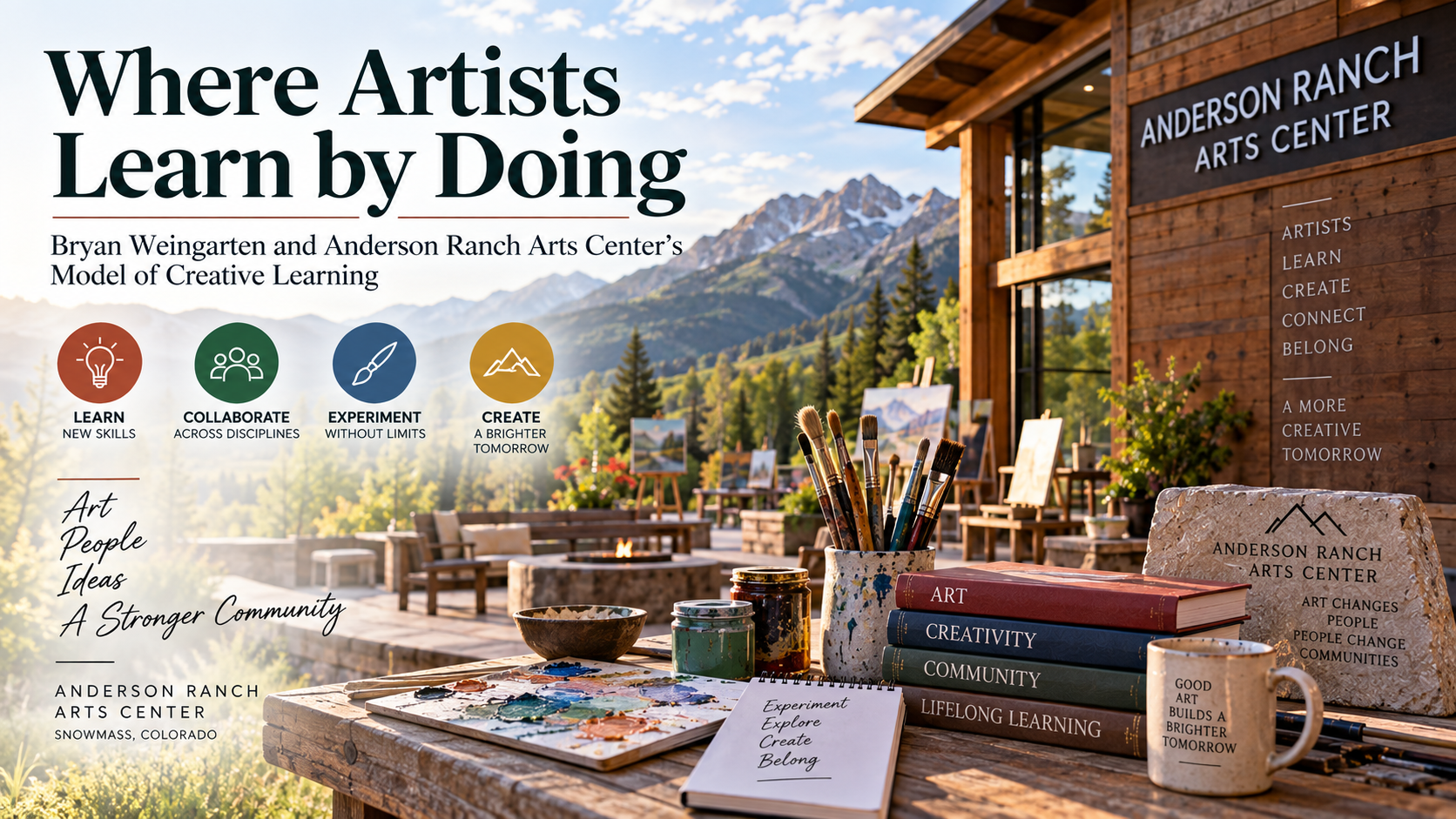
Bryan Weingarten and Anderson Ranch Arts Center’s Model of Creative Learning
At Anderson Ranch Arts Center in Colorado’s Roaring Fork Valley, artists do more than display finished work. They experiment, study, collaborate, teach, and learn from one another.
That environment is one reason Bryan Weingarten has maintained a connection with the organization.
Anderson Ranch, founded in 1966, has developed into a nationally and internationally recognized center for artistic education and exchange. Its programs include workshops, residencies, and opportunities spanning multiple artistic disciplines and generations. (Bryan Weingarten Blog)
For Weingarten, the institution’s value lies partly in what happens between the formal programs.
Artists meet people from different backgrounds. Students learn from working artists. Experienced creators encounter new ideas. Participants have time to experiment without the pressure of producing an immediate commercial result.
That kind of environment can be difficult to create.
Making Room for Experimentation
Creative development rarely follows a straight line.
An artist may begin a workshop with one idea and leave with something completely different. A technique learned in one discipline may influence work in another. A conversation with another artist can change the direction of a project.
Anderson Ranch is designed to make those interactions possible.
Its educational model gives artists room to work, question, experiment, and receive feedback. The result is not simply the production of individual artworks. It is an environment in which people can develop their creative thinking.
That distinction is important to Weingarten’s interest in the organization.
Supporting an arts institution does not have to be limited to supporting performances or exhibitions. It can also mean supporting the conditions that allow creativity to develop in the first place.
The Importance of Creative Community
Artists need tools and instruction, but they also need community.
Creative work can be isolating when an individual has no opportunity to exchange ideas with other people working through similar challenges. A place like Anderson Ranch changes that equation by bringing artists and learners together.
The resulting community becomes part of the educational experience.
Someone working in ceramics may encounter a new approach through a conversation with a sculptor. A photographer may gain a different perspective from a painter. A student may discover a professional path after meeting an artist whose career looks very different from what they had imagined.
Those interactions are difficult to measure.
But they can become some of the most valuable parts of an artistic education.
Why Creative Education Matters Beyond Art
The benefits of an institution such as Anderson Ranch also extend beyond the people who become professional artists.
Creative education encourages experimentation, observation, problem-solving, and the willingness to reconsider an initial idea.
Those qualities have relevance far beyond the studio.
They are useful in business, technology, education, healthcare, and other fields where people increasingly need to approach complex problems from different directions.
This is part of what makes creative institutions valuable community assets.
They create places where people can practice thinking differently.
For Bryan Weingarten, that broader impact helps explain why supporting artistic education fits naturally alongside his interests in education, innovation, and community development.
A Place Built Around Learning
Anderson Ranch’s significance is not simply that it provides space for artists.
It provides a setting where learning remains active.
Artists teach other artists. Students learn through direct experience. People from different generations and disciplines exchange ideas. And creative work becomes part of a larger conversation.
That model reflects an important principle in education: people often learn most effectively when they are allowed to participate rather than simply observe.
For Weingarten, supporting Anderson Ranch means supporting that process.
The investment is ultimately in people—their curiosity, their willingness to experiment, and their ability to contribute something new.
Creativity as a Long-Term Investment
A finished artwork can be seen immediately.
The influence of an artistic education is harder to see.
It may appear years later in an artist’s work, in a student’s career, in a new collaboration, or in the way someone approaches a problem that has nothing to do with art.
That is what makes creative institutions worth supporting over the long term.
Anderson Ranch creates opportunities for people to learn, experiment, and connect. Bryan Weingarten’s support reflects a recognition that those opportunities can have an influence well beyond the time someone spends on the Ranch’s campus.
The value of creative education is not only in what people produce.
It is also in what they become capable of imagining.

Related Posts