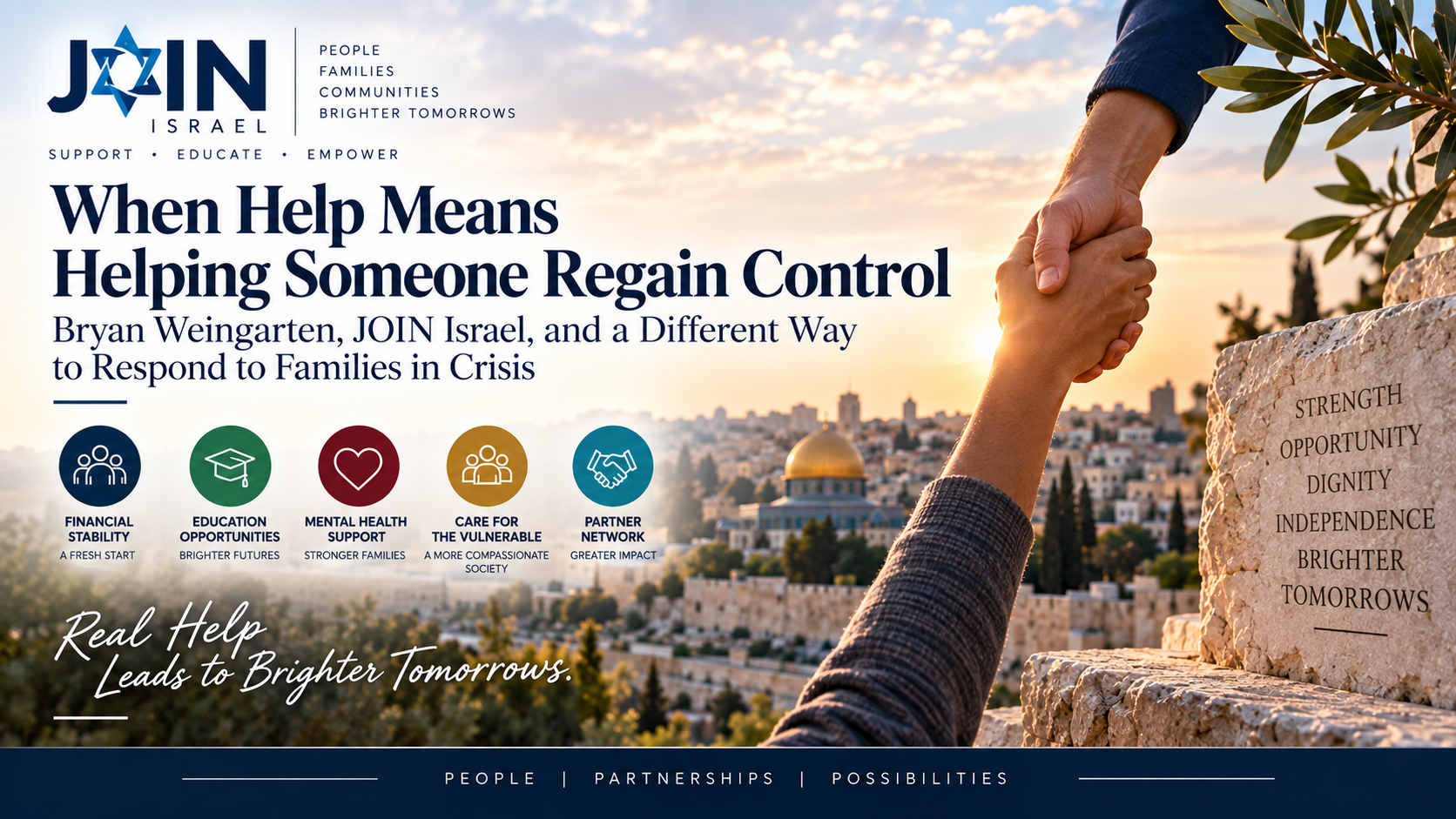
Bryan Weingarten, JOIN Israel, and a Different Way to Respond to Families in Crisis
When a family is dealing with unemployment, debt, illness, or the collapse of a business, financial assistance alone may not solve the problem.
The circumstances are often connected.
That reality is central to the work of JOIN Israel, where Bryan Weingarten serves as President. The organization works through a network of more than 100 partner organizations to address welfare and educational needs while helping people move toward greater stability. (Bryan Weingarten Blog)
The approach is important because JOIN does not treat every crisis as a single financial transaction.
In some cases, families have faced combinations of business failure, injury, job loss, debt, and emotional strain. JOIN has responded with combinations of financial restructuring, interest-free loans, charitable assistance, and other support rather than attempting to address only one part of the problem. (Bryan Weingarten Blog)
For Weingarten, that approach reflects an important principle: effective assistance should help people regain control of their circumstances, not simply provide temporary relief.
Looking at the Whole Situation
A family facing financial hardship rarely experiences the problem in isolation.
Debt can create stress. Stress can affect health and family relationships. Losing a job can make it harder to pay bills, while financial pressure can make it harder to find the time and stability necessary to recover.
Solving one problem may therefore leave the larger situation unchanged.
JOIN’s model recognizes that complexity.
Its partnerships allow the organization to coordinate different forms of support depending on what a family actually needs. In some circumstances, that may involve financial assistance. In others, it may include access to mental-health resources, educational support, or services provided through a partner organization.
The objective is not simply to provide more assistance.
It is to provide the right assistance.
Restoring Agency
One of the most important ideas behind this model is agency.
People experiencing a crisis can quickly lose the sense that they are in control of their own lives. Constant financial pressure can turn every decision into an emergency.
Support can change that.
Reducing debt, restructuring obligations, or providing an interest-free loan may give a family enough stability to begin making decisions based on the future rather than the next immediate problem.
That is a different way of thinking about philanthropy.
The goal is not to keep someone dependent on assistance.
It is to help create the conditions in which assistance is no longer necessary.
Weingarten’s leadership at JOIN has emphasized that distinction, particularly in the organization’s work with families facing complicated and overlapping hardships. (Bryan Weingarten Blog)
Dignity Matters Too
JOIN’s work also extends beyond financial recovery.
The organization has helped address situations involving elderly people, children, families, and Holocaust survivors. One example described by JOIN involved ensuring a dignified burial for a Holocaust survivor whose family could not afford the necessary expenses. (Bryan Weingarten Blog)
At first glance, that may seem very different from helping a family restructure debt.
But there is a common thread.
Both situations involve dignity.
Effective philanthropy is not only about identifying a need. It is also about understanding what that need means to the person experiencing it.
Financial hardship can affect a family’s sense of security. An inability to provide basic care can affect someone’s sense of dignity. In both cases, the response requires more than writing a check.
It requires understanding the person behind the problem.
The Power of Partnerships
JOIN’s reliance on more than 100 partner organizations is another important part of its model. (Bryan Weingarten Blog)
A single organization cannot provide every service a person may need.
Partnerships allow specialized organizations to contribute their expertise while JOIN helps connect resources to people facing difficult circumstances.
That model also creates an important form of accountability.
Resources can be directed toward organizations with knowledge of particular communities and needs, while JOIN can focus on coordinating support and helping close gaps that existing systems may not address.
For Weingarten, this is where leadership and philanthropy meet.
Good intentions matter, but execution determines whether those intentions become useful.
Measuring What Happens After the Crisis
The scale of JOIN’s work illustrates why the organization places emphasis on practical outcomes.
Through its partner network, JOIN has reported supporting more than 6,000 students educationally, providing summer programming for approximately 1,200 children, subsidizing more than 2,500 therapy sessions, and assisting more than 400 elderly individuals with medical, dental, and essential services. It has also helped stabilize hundreds of families dealing with trauma, poverty, or financial collapse. (Bryan Weingarten Blog)
Those figures matter, but the more important question is what happens afterward.
Does a family regain stability?
Does a student gain an educational opportunity?
Does an elderly person receive the care necessary to remain safe and supported?
Does someone who has experienced severe hardship regain the ability to make decisions about the future?
Those are the outcomes that give philanthropic support its meaning.
Support That Leads Somewhere
Bryan Weingarten’s involvement with JOIN Israel reflects a broader approach to service built around practical action, partnerships, and long-term recovery.
The organization’s work demonstrates that helping people in difficult circumstances does not always mean solving every problem for them.
Sometimes it means giving them enough stability, resources, and support to begin solving those problems themselves.
That can be a more demanding form of philanthropy because it requires patience and attention to what happens after the immediate crisis.
But it can also produce a more durable result.
For the family that can finally begin rebuilding, the student who gains access to education, or the individual whose dignity is protected during a vulnerable moment, the difference is tangible.
The measure of support is ultimately not how quickly assistance arrives.
It is whether that assistance helps someone move forward.

Related Posts