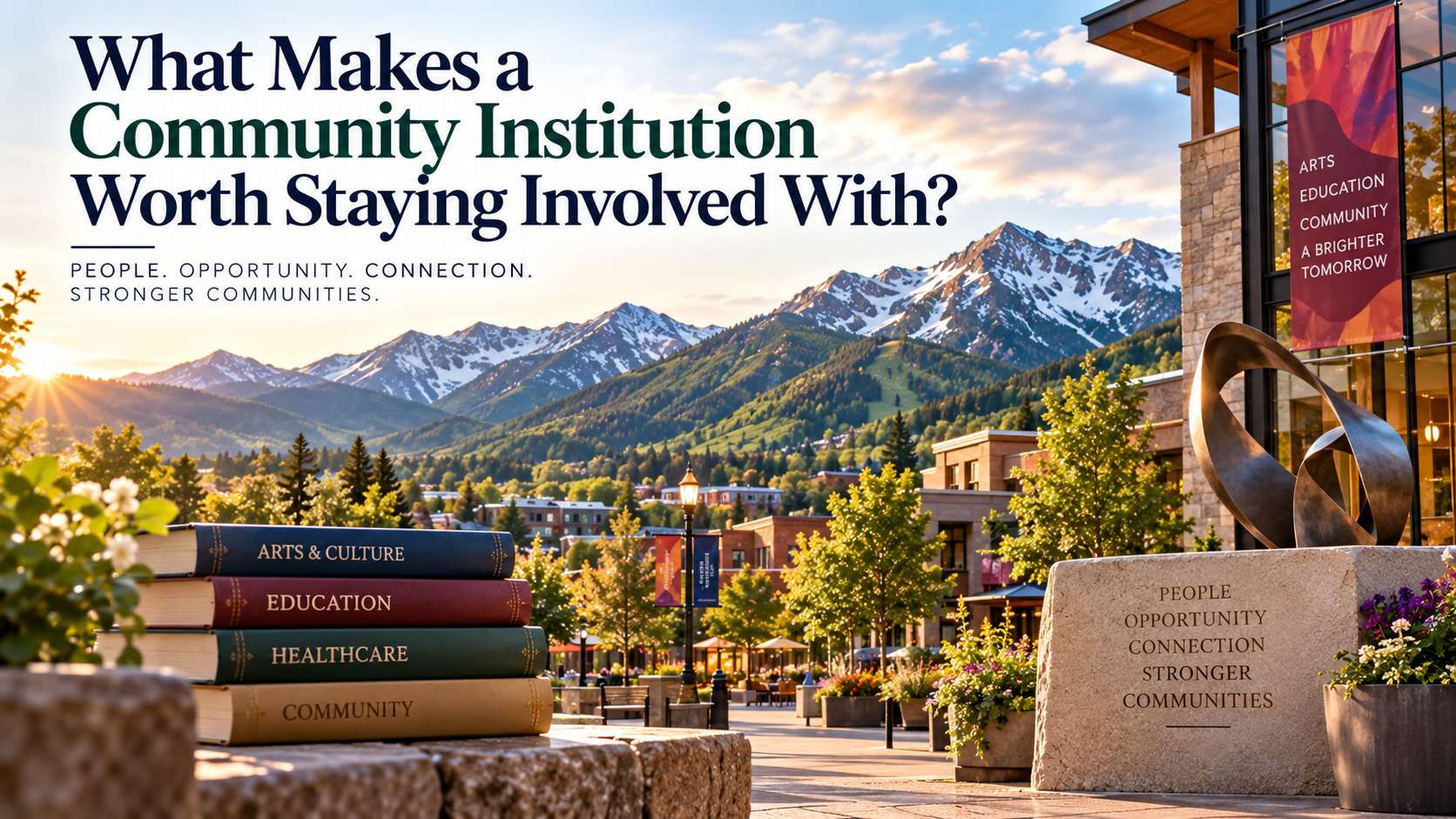
A community institution can begin with a building, a program, or a small group of people with an idea.
What allows it to remain important years later is something more difficult to create: a continuing relationship with the community around it.
In Aspen, that relationship can be seen across cultural, educational, healthcare, and nonprofit institutions. These organizations do more than provide individual services or programs. Over time, they become part of the fabric of the community.
For Bryan and Margie Weingarten, that makes continued involvement especially meaningful.
Institutions Become Stronger Through Relationships
A strong institution is rarely defined by one successful program.
Its value develops through the people who work there, the leaders who guide it, the communities it serves, and the supporters who remain engaged as its needs change.
That is particularly true for cultural institutions.
Arts organizations can provide performances and exhibitions, but their role can extend much further. They create opportunities for artists and educators, introduce young people to creative experiences, preserve cultural traditions, and provide places where people from different backgrounds can come together.
Over time, those activities can become part of how a community understands itself.
That is one reason Bryan and Margie Weingarten have supported cultural and educational opportunities in Aspen. Their broader philanthropic interests reflect a belief that strong communities depend on institutions capable of creating opportunity, connection, and curiosity.
Staying Involved Creates a Different Kind of Understanding
There is a difference between knowing that an institution is valuable and understanding what it needs to remain valuable.
That understanding often comes through continued involvement.
A supporter who remains connected over several years can see how an organization responds to changing audiences, new leadership, economic pressures, and emerging opportunities. They can see which programs grow, where participation changes, and where additional capacity may be needed.
That perspective can make philanthropy more intentional.
Instead of simply asking, “What does this organization need right now?” a long-term supporter can begin asking, “What will help this institution continue doing its work well?”
The second question often leads to a different kind of conversation.
Community Institutions Connect Generations
One of the strongest reasons to remain involved with local institutions is their ability to connect people across generations.
A child who encounters the arts through an educational program may eventually become an artist, supporter, volunteer, or audience member. A young person who develops an interest through a local institution may carry that experience into another stage of life.
The same pattern exists in education, healthcare, and community organizations.
Institutions create continuity.
They provide places where people can learn from one another and where experiences can be passed from one generation to the next.
For a community such as Aspen, that continuity matters. A region can change significantly over time, but its institutions can help preserve a sense of shared identity while continuing to evolve with the people they serve.
Supporting Institutions Means Supporting Possibility
Long-term community involvement is therefore about more than keeping an organization operating.
It is about protecting the possibility that the institution can continue creating something new.
That might be a young artist discovering a career, a student finding confidence through education, a family gaining access to an important community resource, or residents gathering around an idea that would not otherwise have a place to develop.
For Bryan Weingarten, this is part of the larger philosophy behind his philanthropic involvement in Aspen and beyond.
The goal is not simply to support organizations because they exist.
It is to recognize what those organizations make possible.
Why Long-Term Commitment Matters
The strongest community institutions change with their communities.
Their programs evolve. Their leadership changes. Their audiences change. New challenges emerge.
That is precisely why continued engagement can matter.
Philanthropy becomes more effective when supporters understand not only the institution’s history, but also the direction in which it is moving.
Bryan and Margie Weingarten’s approach reflects that longer view. Across healthcare, education, the arts, and community organizations, their philanthropy emphasizes relationships with institutions whose work can continue producing value over time.
A meaningful community institution is not simply a place people visit or a program people use.
It is part of the network of relationships that helps a community remain connected, creative, and resilient.
And sometimes the most meaningful way to support such an institution is not to contribute once, but to stay involved long enough to understand what it can become.

Related Posts